Ora-Predazzo railway line

Predazzo is the terminus of the Ora-Predazzo railway line. The last train on this line ran on 10 January 1963, after which the railway was decommissioned.
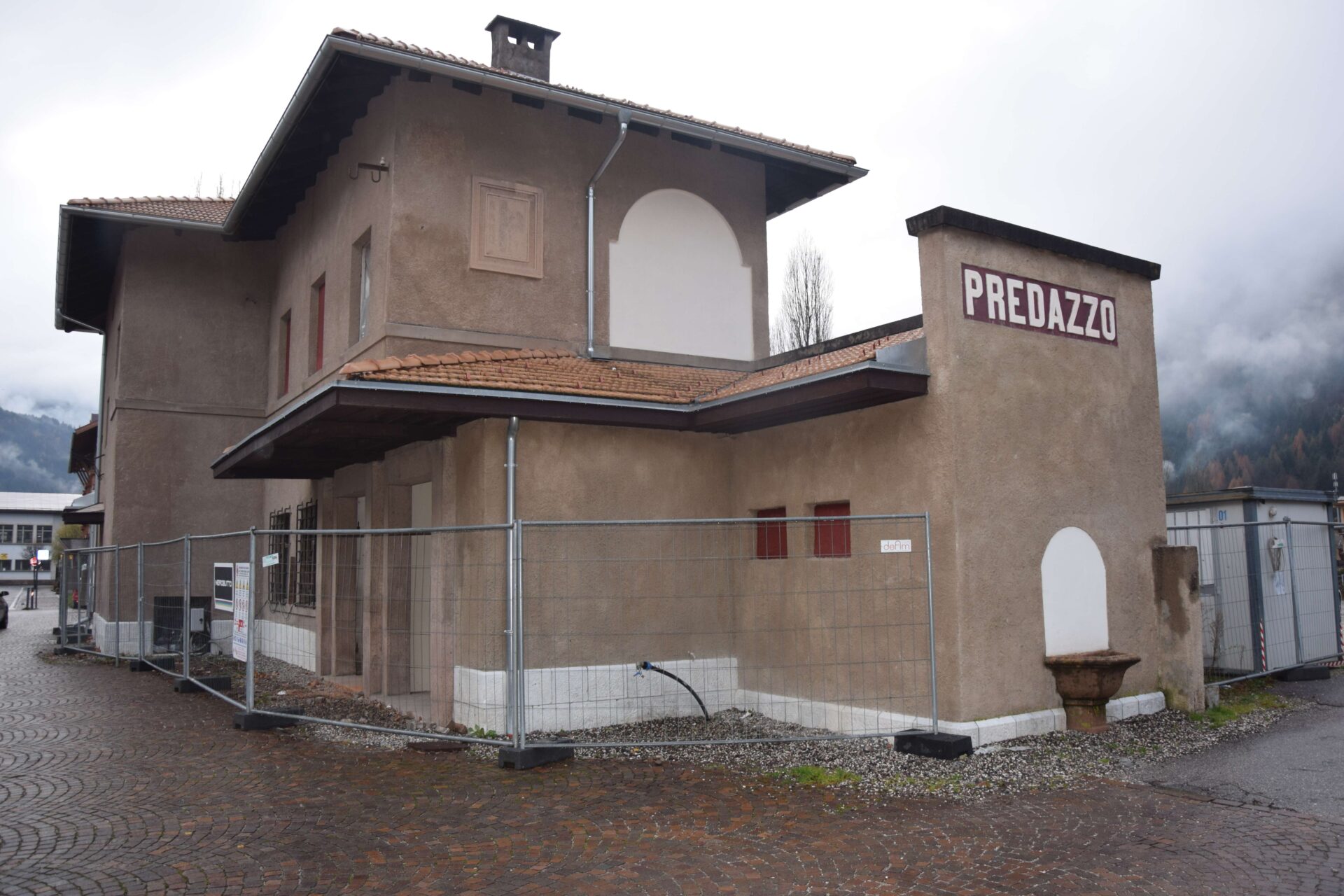
The historic Predazzo railway station is located near the Biblioteca la Stazione library. Designed by architect Ettore Sottsass, it was recently renovated (based on a design by architect Paolo Chiocchetti) and converted into a municipal library. It has become an important cultural centre for the town, which also celebrates its railway history with initiatives and exhibitions.
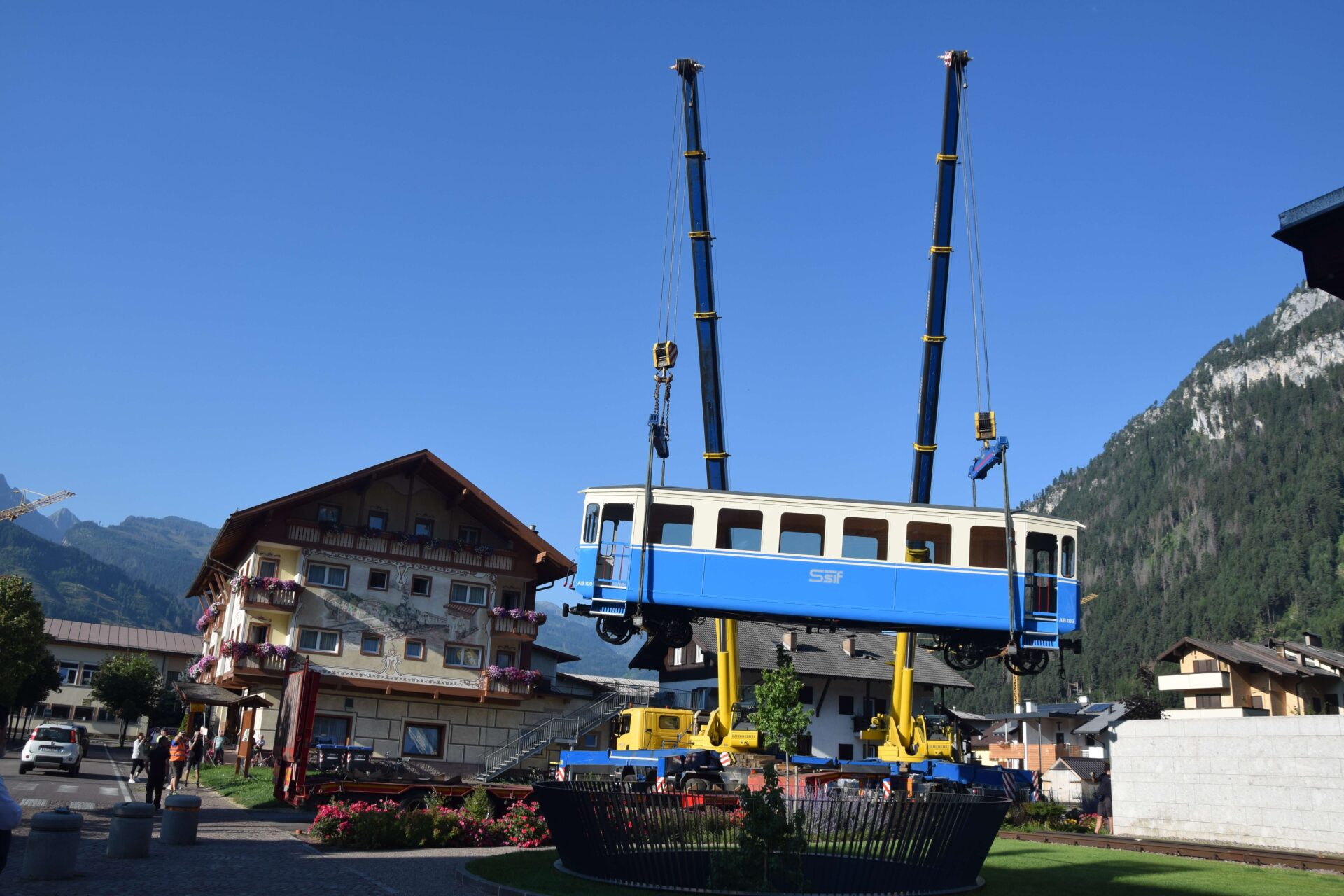
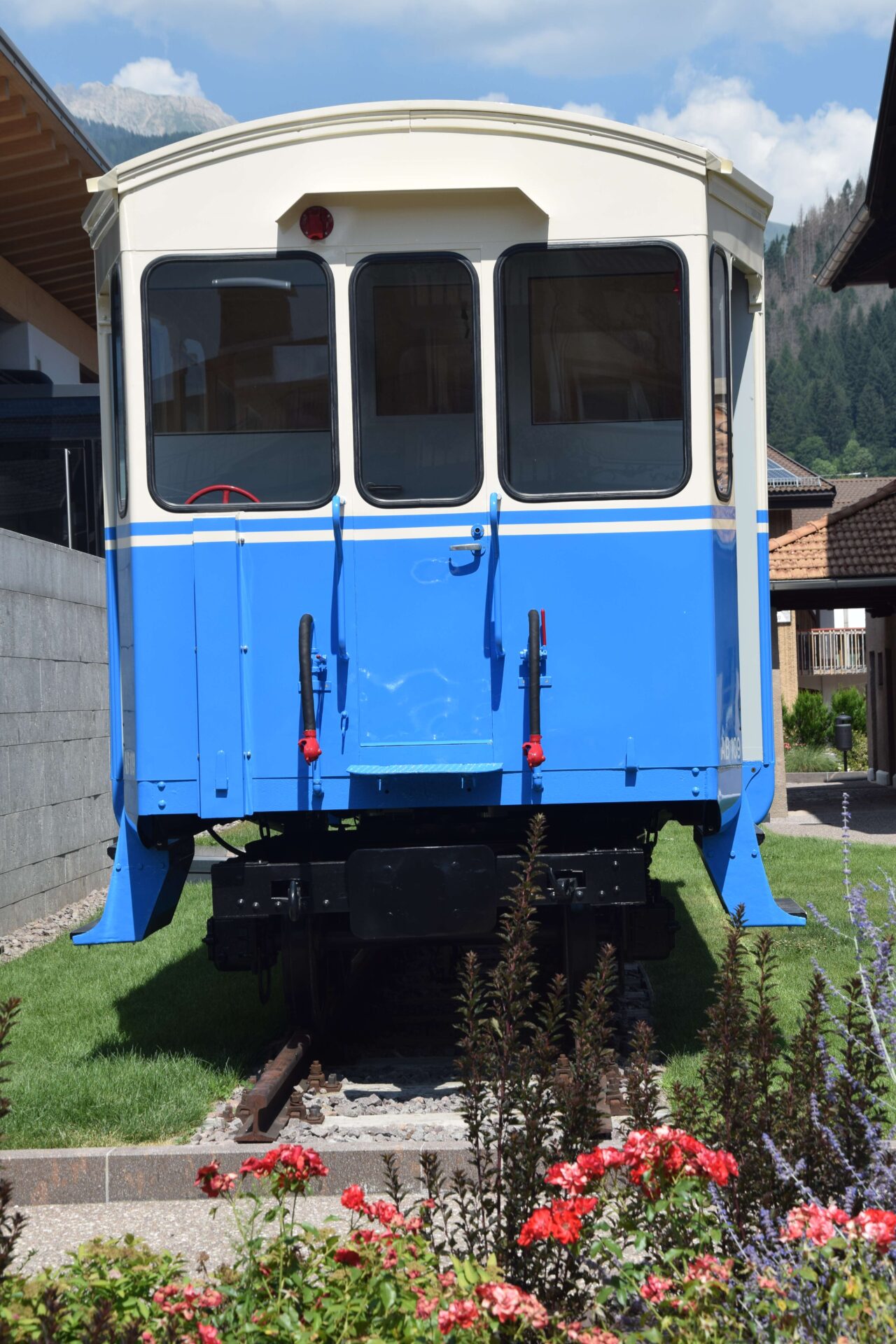
On 30 July 2024, the newly restored AB 109 railway carriage was exhibited on the railway site as part of the project of the Museo Diffuso (Open-Air Museum) in memory of the Val di Fiemme Railway. Built in 1922 by Carminati & Toselli, it was part of the fleet of trailers belonging to the SSIF, Società Subalpina di Imprese Ferroviarie (Vigezzina Centovalli Railway).
Val di Fiemme Railway
The Val di Fiemme railway was a narrow-gauge railway built by the Austrian military engineering corps. Construction began in the winter of 1916 and it was operational from 1917 to 1963, connecting the Brenner railway to the Val di Fiemme.
The first ideas for a railway in Val di Fiemme began to take shape at the end of the 19th century. Two different projects were proposed: one by Paolo Oss Mazzurana, mayor of Trento, who proposed access to the Val di Fiemme starting from Lavis and going up the Cembra valley to reach Predazzo, and a second supported by Bolzano, which favoured the Egna-Predazzo-Moena axis.
These two proposals led to a sometimes bitter debate between the supporters of one or the other.
Italy’s entry into the First World War in May 1915 accelerated the construction of the Ora-Predazzo section, shelving the Lavis route. The objective of transporting an entire infantry brigade, complete with equipment and weapons, from Ora to Val di Fiemme in 24 hours led the Austro-Hungarian Empire’s general staff to adopt the project favoured by the city of Bolzano. Given the limited time available, and to avoid the costly construction of a bridge over the Adige River, the junction with the Brenner line was moved from Egna to Ora.
Austro-Hungarian construction and operation
Despite the priorities of the war, the railway was built with a view to subsequent civilian and tourist use: infrastructure, sleepers and newly built rolling stock were designed from the outset to allow for easy migration from the initial 750 mm gauge to 1000 mm and eventual electrification. The line’s tourist appeal, with its panoramic sections of such great value that it was called the “Ferrovia del Paradiso” (Railway of Paradise), Work began in the winter of 1915-16. The workforce reached a peak of 6,000 men: 3,900 civilians, 600 military personnel and 1,500 prisoners, mainly Serbs, Russians and Montenegrins. Many of the latter perished from disease and deprivation. Numerous women also contributed to the construction, especially in the final section of the line. 1917 was a year of severe famine, causing great suffering and death among the population and military personnel. For the local women who worked on the final stages of construction, this represented an opportunity to secure food.
Designed as the hub of an extensive transport system which, together with the Trento-Malé-Mezzana railway and the Dolomites railway, was to form the extension from Tirano of the Swiss Alpine transversal, the Ora Val di Fiemme station was the largest narrow-gauge railway in the empire, comprising 8.2 km of track and 85 points.
The Ora-Cavalese section was inaugurated on 23 June 1917. However, the Italian conquest of Mount Cauriol (Lagorai chain) forced the designer, engineer Orley, to modify the route towards the valley floor to prevent the railway from being hit by Italian howitzers positioned on the mountain. As a result, the Cavalese-Predazzo section only entered into service on 1 February 1918, by which time the Lagorai area had become a rear area due to the retreat of the Italian front following the defeat at Caporetto.
The transition to Italy
The Habsburg management of the railway lasted less than a year, as the war ended in November 1918 and Trentino-Alto Adige passed to Italy.
Journey times exceeded four hours; in order to reduce them, the recently opened Villa and Castel d’Enna stops were closed and the Fontanefredde and Ziano stops were converted into stations.
Management by FEVF, Ferrovia Elettrica della Val di Fiemme (Val di Fiemme Electric Railway)
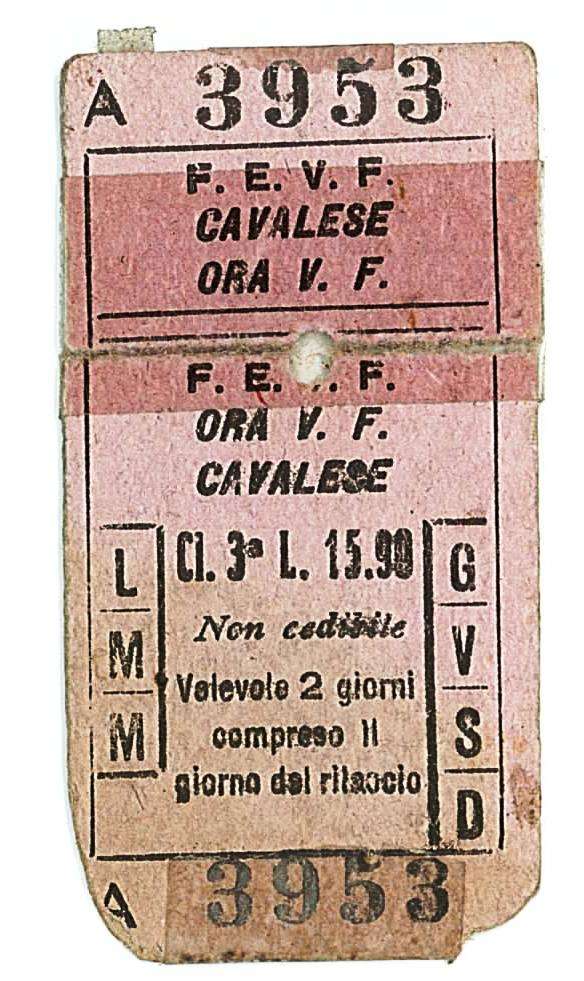
The management of the state railways ceased on 31 December 1927 and was transferred to Ferrovia Elettrica Val di Fiemme (FEVF), a specially established company that had obtained the concession for the refurbishment, electrification and operation of the Ora-Predazzo line. A transverse suspension line was built, supported in stations by reinforced concrete poles, while larch wood was used along the line. The gauge was increased to 1 metre. On 28 October 1929, electrification was inaugurated and journey times were reduced to 2 hours and 15 minutes.
Following electrification, passenger traffic increased rapidly, so much so that in 1932 there were ten passenger trains a day, in addition to several long freight trains loaded with timber, minerals and other products from the valley.
During the Second World War, activity, although reduced to a minimum, was never completely interrupted. After the war, the line experienced a revival in both freight and passenger transport on the wave of tourism development in the valley.
In 1963, following the relentless development of road transport, it was decided to close the line on 10 January, and within a few years it was dismantled. All the rolling stock (traction units, locomotives, carriages and all freight wagons) and power transformers were sold to the Genoa-Casella Railway.
The memory of the FEVF lives on.
A few decades after its decommissioning, much of the railway line was converted into a scenic cycle path that climbs from Ora (BZ) to the terminus in Predazzo. With the construction of cycle paths in Val di Fassa, the cycling and walking experience extends to the top of Val di Fassa, while in Bassa Atesina, the same cycle path is connected to the paths that branch off towards Lake Caldaro to the west, Bolzano to the north and Salorno-Trento to the south.
In 2013, the Transdolomites Association promoted a series of initiatives to commemorate the 50th anniversary of the decommissioning of the historic Val di Fiemme railway. The programme of events began in May 2013 and ran until November of the same year, involving all the municipalities from Ora to Predazzo to Canazei.
The main event in May was the special transport and exhibition of the B51 electric locomotive, which began in Ora (BZ) on 12 June 2013 and continued in various stages from Ora to Canazei until 9 July.
The B51 is one of the electric locomotives in service on the Ora-Predazzo line. In 1963, it was moved to the Genoa-Casella line, and in 2008, it was purchased by Trentino Trasporti in poor condition for restoration. In October 2029, it was put back into service on the Trento-Mezzana line to mark the 100th anniversary of the Trento-Malè line. The aim was to use it for historic trains.
After the wonderful experience of 1963, Transdolomites proposed to perpetuate the historical memory of the Val di Fiemme Railway by suggesting the idea of creating a museum spread between Ora and Predazzo, to be housed in railway buildings and along the open-air route. This is the first museum project in Italy dedicated to 1000 mm gauge mountain railways.
Georeferencing of the route, installation of signs bearing the names and lengths of bridges, viaducts and tunnels, and installation of thematic signs are some of the guidelines on which the project is being developed. Another key point is the restoration of the freight wagon that was used on the Ora-Predazzo line and three passenger carriages that were used on the Domodossola-Locarno line.
The four rolling stock items were lying unused in Casella and, in 2017, the Liguria Region donated them to Transdolomites in support of the museum project. Transdolomites then transported them to a depot in Ora between 2018 and 2019, where they awaited restoration.
In 2024, the Municipality of Predazzo, interested in one of the passenger carriages, completed the restoration of Carriage AB109, which has been on display since 30 July of the same year next to the small station designed by architect Ettore Sottsass, which had also been restored previously.
The plan is to continue with the restoration of the remaining rolling stock.
The overall aim of the project is to promote the recovery of the historical memory of the Val di Fiemme Railway on a cultural route that can be travelled on foot, by bicycle or by public transport, to promote knowledge of the places along the route, to include the route in the Atlas of Gentle Mobility created by Alleanza Mobilità Dolce and RFI (Italian Railway Network), and to include the museum in the network of railway museums in Italy and the European Union.
Another social aim of the initiative is to promote twinning between the territories of the Ora-Predazzo Railway and the territories of Genoa-Casella.